

Description
Food Thermometer Calibration Safety Poster
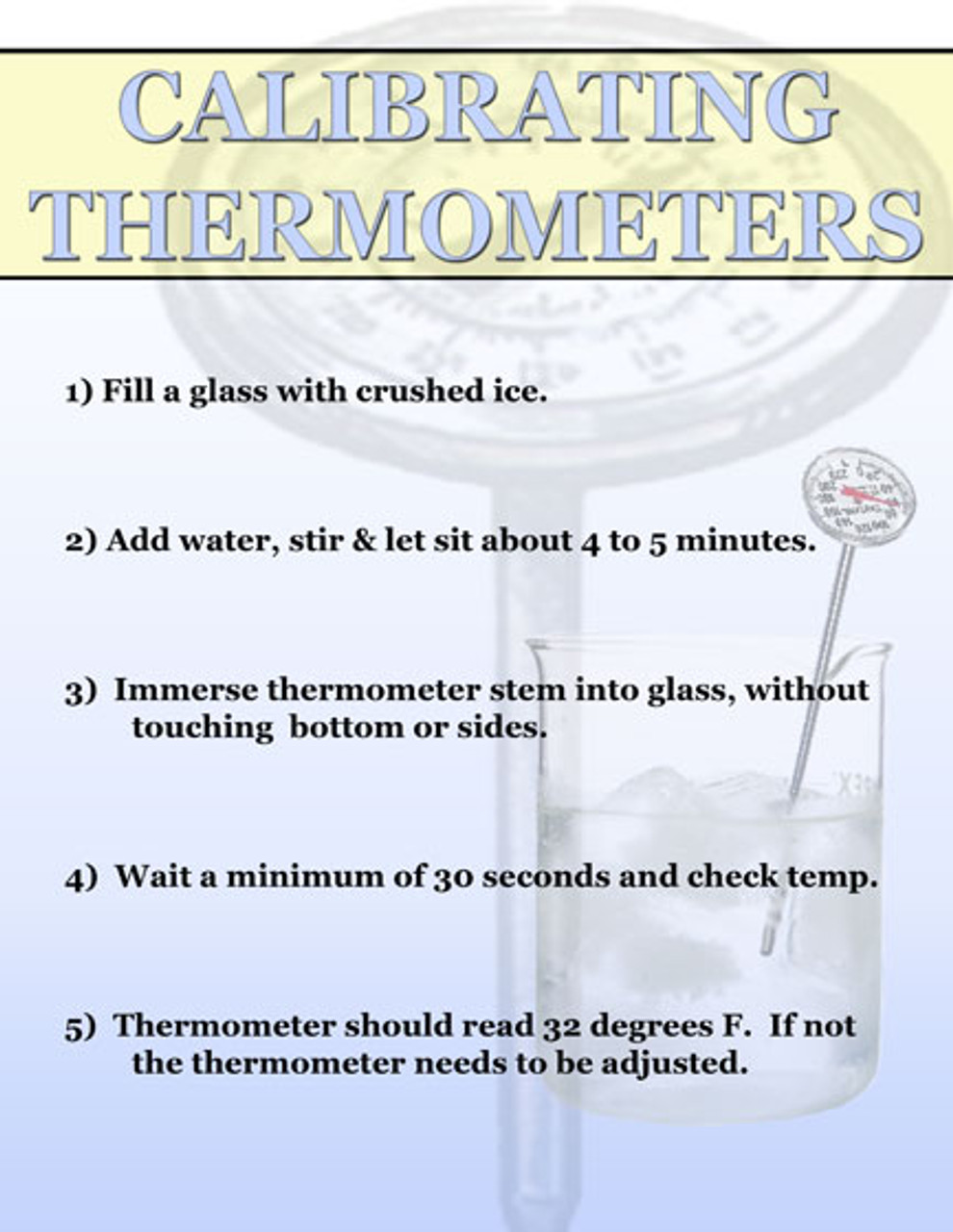
Help employees maintain accurate food temperature measurements with the Food Thermometer Calibration Safety Poster. This easy-to-read workplace poster provides a visual reminder of the steps used to check and calibrate food thermometers for accurate temperature readings.
Accurate thermometers are an important part of food safety. Restaurants, commercial kitchens, food-service operations, and other food establishments rely on temperature measurements to determine whether foods are being cooked, cooled, held, and stored at appropriate temperatures.
Why Is Food Thermometer Calibration Important?
A thermometer that provides an inaccurate reading can make it difficult to determine whether food has reached or maintained a safe temperature. Regularly checking thermometer accuracy helps employees identify instruments that need adjustment, recalibration, or replacement.
Food thermometers can lose accuracy after being dropped, exposed to extreme temperature changes, or through normal use. Employees should follow workplace procedures and the thermometer manufacturer's instructions for checking accuracy and calibration.
How Do You Calibrate a Food Thermometer?
One of the most common methods for checking the accuracy of a food thermometer is the ice-point method. USDA identifies ice water as the preferred calibration method for most food thermometers.
General steps for checking a thermometer using ice water include:
- Fill a large container with ice.
- Add clean drinking water and stir the mixture thoroughly.
- Place the thermometer stem or probe into the ice-water mixture without touching the sides or bottom of the container.
- Allow the reading to stabilize according to the thermometer manufacturer's instructions.
- Verify that the thermometer reads approximately 32°F (0°C) and adjust the thermometer according to manufacturer instructions when calibration is necessary and the device is adjustable.
What Is the Ice-Point Calibration Method?
The ice-point method uses a properly prepared mixture of ice and water to create a known reference temperature of approximately 32°F (0°C). The thermometer is placed into the mixture and its reading is compared with the expected temperature.
The sensing area of the thermometer should be sufficiently immersed in the ice-water mixture without allowing the probe to touch the container's sides or bottom.
Can You Use Boiling Water to Calibrate a Thermometer?
Boiling water can also be used to check the accuracy of certain food thermometers. At sea level, boiling water is approximately 212°F (100°C).
However, the boiling point of water changes with altitude and atmospheric pressure. Employees using the boiling-point method should account for local elevation and follow the thermometer manufacturer's calibration instructions.
When Should a Food Thermometer Be Checked for Accuracy?
The appropriate calibration frequency depends on the thermometer, workplace procedures, manufacturer instructions, and applicable food safety requirements. A thermometer should also be checked whenever there is reason to question its accuracy.
Situations that may justify checking thermometer accuracy include:
- After the thermometer has been dropped
- After exposure to extreme temperature changes
- When temperature readings appear inconsistent
- Before important food-temperature measurements when required by workplace procedures
- At intervals established by the food establishment's food safety program
FDA Food Code and Thermometer Accuracy
The FDA Food Code establishes model food-safety provisions addressing food temperature measuring devices, including accuracy, functionality, availability, and maintenance. Food temperature measuring devices should provide reliable readings within the intended temperature range.
The FDA Food Code is a model code used by state, local, tribal, and territorial jurisdictions when developing or updating retail and food-service regulations. Employers should follow the food safety requirements adopted by the jurisdiction where their establishment operates.
Where Should a Food Thermometer Be Placed in Food?
Accurate calibration is only part of obtaining a reliable food-temperature reading. Employees must also place the thermometer correctly in the food.
For many foods, the thermometer should be inserted into the thickest portion and positioned away from bone, fat, or gristle. Thin foods may require a small-diameter probe or insertion from the side so the sensing area reaches the center of the food.
Keep Food Thermometers Clean
Food thermometer probes should be cleaned according to workplace procedures and manufacturer instructions. Proper cleaning and sanitation can help prevent contamination when thermometers are used with different foods.
Employees should also protect thermometer probes from damage and store temperature-measuring devices appropriately when they are not being used.
Where Can a Thermometer Calibration Poster Be Displayed?
The Food Thermometer Calibration Safety Poster can provide a useful employee reference in locations such as:
- Restaurants
- Commercial kitchens
- Food processing facilities
- School and institutional cafeterias
- Hotels and hospitality kitchens
- Grocery store kitchens and delis
- Catering operations
- Healthcare food-service operations
- Food preparation areas
- Employee food-safety training areas
Is a Thermometer Calibration Poster Required?
Food establishments may be subject to federal, state, and local requirements regarding food-temperature measuring devices and their accuracy. However, this particular Food Thermometer Calibration Safety Poster is intended as a supplemental employee food-safety and training resource and should not be represented as a universally required workplace poster.
This poster does not replace applicable food-safety regulations, employee training, a food establishment's procedures, thermometer manufacturer instructions, or other requirements adopted by the applicable regulatory authority.
Calibrating Thermometers Poster Specifications
- 8.5"W x 11"H
- Portrait orientation
- Printed in full color
- Laminated with high-quality laminate
Food Safety and Workplace Compliance Resources
Labor Law Compliance Center provides employers with labor law posters, workplace safety posters, food-safety materials, specialty postings, and compliance resources for businesses throughout the United States. Browse our Workplace Safety Posters for additional food safety, kitchen safety, first aid, emergency response, and employee safety materials.