

Description
U.S. Bill of Rights Constitutional Poster
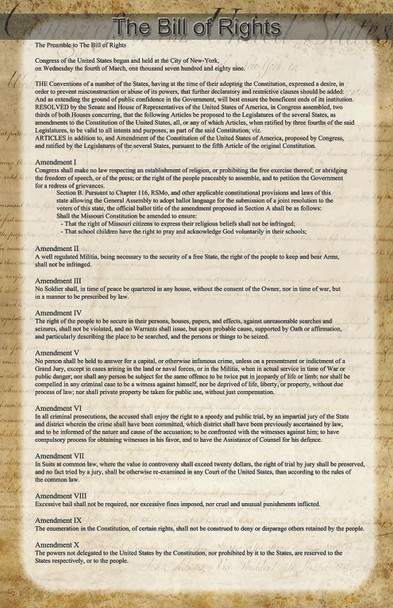
Display the fundamental freedoms and protections contained in the United States Constitution with the U.S. Bill of Rights Constitutional Poster from Labor Law Compliance Center. This 11 x 17-inch laminated educational poster presents the first 10 amendments to the U.S. Constitution in a convenient, easy-to-display format.
Ideal for schools, classrooms, government offices, workplaces, libraries, training facilities, and civic organizations, this full-color Bill of Rights poster provides an educational reference to the constitutional freedoms and protections that form an important foundation of American government.
U.S. Bill of Rights Poster Specifications
- Poster Dimensions: 11"W x 17"H
- Portrait Orientation
- Full-Color Printing
- Laminated for Added Durability
- Displays the First 10 Amendments to the U.S. Constitution
- Designed for Educational and Civic Display
- Suitable for Schools, Government Offices, Workplaces, Libraries, and Public Facilities
What Is the Bill of Rights?
The Bill of Rights is the name commonly given to the first 10 amendments to the United States Constitution.
Congress proposed 12 constitutional amendments in 1789. Ten of those amendments were ratified by the states and became part of the Constitution on December 15, 1791.
What Are the First 10 Amendments?
The Bill of Rights establishes important constitutional protections involving individual liberty and limits on government power.
- First Amendment: Protects freedoms involving religion, speech, press, peaceful assembly, and petitioning the government.
- Second Amendment: Protects the right to keep and bear arms.
- Third Amendment: Restricts the quartering of soldiers in private homes.
- Fourth Amendment: Protects against unreasonable searches and seizures.
- Fifth Amendment: Provides protections involving due process, self-incrimination, double jeopardy, grand juries, and private property.
- Sixth Amendment: Establishes important rights for individuals accused of crimes, including rights involving a speedy and public trial, counsel, witnesses, and an impartial jury.
- Seventh Amendment: Protects the right to a jury trial in certain federal civil cases.
- Eighth Amendment: Prohibits excessive bail, excessive fines, and cruel and unusual punishments.
- Ninth Amendment: Recognizes that the listing of certain constitutional rights does not mean that other rights retained by the people do not exist.
- Tenth Amendment: Reserves powers not delegated to the United States by the Constitution, nor prohibited to the states, to the states or the people.
Why Was the Bill of Rights Added to the Constitution?
During the debate over ratification of the U.S. Constitution, many Americans argued that the Constitution should contain additional protections for individual liberties and limitations on federal government power.
James Madison introduced proposed constitutional amendments in the First Congress in 1789. The amendments that became the Bill of Rights were designed to address many of these concerns and provide explicit constitutional protections for individual rights.
Why Is December 15 Bill of Rights Day?
The Bill of Rights became part of the U.S. Constitution on December 15, 1791, when the required number of states ratified the amendments.
December 15 is recognized as Bill of Rights Day and provides an opportunity for schools, government organizations, workplaces, and communities to learn about constitutional rights.
Bill of Rights Poster for Schools and Civics Education
A Bill of Rights poster provides students with an accessible reference when studying American history, government, civics, constitutional law, and individual liberties.
Educational topics supported by a Bill of Rights display include:
- The United States Constitution
- The Constitutional Convention and ratification debates
- The First Congress
- James Madison and the development of the Bill of Rights
- Freedom of speech and religion
- Rights of individuals accused of crimes
- Federalism and limitations on government power
- American civil liberties
Bill of Rights Poster for Government Offices
Government agencies and public offices may display the Bill of Rights as an educational and civic resource highlighting fundamental constitutional protections and the responsibilities of government.
A Bill of Rights poster can be displayed alongside other historical documents such as the U.S. Constitution, Declaration of Independence, or other civic materials.
Can Businesses Display the Bill of Rights?
Yes. Private employers, nonprofit organizations, professional offices, libraries, training facilities, and other organizations may display the Bill of Rights as an educational or civic resource.
The Bill of Rights poster should not be confused with federal labor law notices that private employers may be legally required to display for employees.
Is the Bill of Rights a Required Federal Workplace Poster?
No. There is no general federal labor law requiring private employers throughout the United States to display a Bill of Rights poster.
This U.S. Bill of Rights Constitutional Poster is an educational and civic resource rather than a universally required federal workplace notice.
Employers should separately maintain applicable required federal employee-rights notices such as the OSHA Job Safety and Health poster, FLSA Minimum Wage poster, EEOC Know Your Rights notice, Employee Polygraph Protection Act poster, FMLA notice when applicable, and other required federal or state workplace postings.
Where Can a Bill of Rights Poster Be Displayed?
The U.S. Bill of Rights Constitutional Poster provides a useful civic and educational reference in locations such as:
- Schools and classrooms
- Libraries
- Government offices
- Public buildings
- Employee training areas
- Conference rooms
- Community centers
- Courthouses and legal offices
- Universities and colleges
- Civic organizations
- Private workplaces
Bill of Rights and the U.S. Constitution
The Bill of Rights is part of the United States Constitution and has the same constitutional authority as other ratified amendments.
Additional amendments adopted after the Bill of Rights expanded or clarified constitutional protections, but the term Bill of Rights specifically refers to the first 10 amendments.
Benefits of Displaying a U.S. Bill of Rights Poster
Displaying the Bill of Rights can support civic education and provide a convenient reference to the constitutional amendments that protect important individual freedoms.
- Supports classroom instruction and civic education.
- Provides a visual reference to the first 10 constitutional amendments.
- Encourages awareness of constitutional rights and American history.
- Suitable for schools, libraries, and government facilities.
- Provides an educational display for workplaces and training areas.
- Features a laminated finish for added durability.
Frequently Asked Questions About Bill of Rights Posters
What is included on the U.S. Bill of Rights Poster?
The poster presents the first 10 amendments to the United States Constitution, which establish important protections involving individual liberty and limitations on government power.
Is the Bill of Rights poster required by federal labor law?
No. A Bill of Rights poster is an educational and civic resource. It is not a universally required federal workplace labor law poster.
When was the Bill of Rights ratified?
The first 10 amendments became part of the U.S. Constitution on December 15, 1791.
Can schools use the Bill of Rights Poster for classroom instruction?
Yes. The poster can serve as an educational reference for lessons involving American government, history, constitutional law, and civic rights.
Can the Bill of Rights Poster be displayed in government offices?
Yes. Government offices, public facilities, and civic organizations may display the poster as an educational reference to constitutional protections.
What size is the U.S. Bill of Rights Poster?
The poster measures 11 inches wide by 17 inches high, features portrait orientation and full-color printing, and is laminated for durability.
Federal and Workplace Compliance Resources
Labor Law Compliance Center provides schools, government agencies, employers, and organizations with federal and state labor law posters, workplace notices, educational posters, specialty postings, and compliance resources throughout the United States.
Browse our Federal Specialty Posters for additional workplace, government, and educational notices.
For generally required federal employment notices, explore our Federal Labor Law Posters collection.
Employers can also browse our State and Federal Combination Labor Law Posters for available workplace posting solutions.
Compliance note: This Bill of Rights poster is an educational and civic resource. It is not a substitute for required federal, state, or local workplace notices.


