Description
OSHA Whistleblower Protection Program Poster
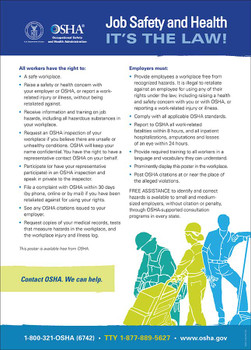
Help employees understand their rights against workplace retaliation with the OSHA Whistleblower Protection Program Poster. This workplace rights poster provides employees with information about federal whistleblower protections administered by the Occupational Safety and Health Administration (OSHA), including protected activities, retaliation, complaint procedures, and important filing deadlines.
OSHA's Whistleblower Protection Program enforces whistleblower provisions under more than 20 federal laws protecting employees who report certain workplace safety, transportation, environmental, consumer product, financial, and other violations.
What Is OSHA Whistleblower Protection?
Whistleblower protection laws prohibit covered employers from retaliating against employees for engaging in activities protected by applicable federal law.
Depending on the statute involved, protected activities may include reporting workplace safety or health concerns, reporting violations of federal laws or regulations, participating in investigations, providing information to government agencies, or exercising other legally protected employee rights.
What Employee Activities May Be Protected?
Protected whistleblower activity depends on the federal law involved. Examples may include:
- Reporting unsafe or unhealthy workplace conditions
- Filing a workplace safety or health complaint
- Reporting a work-related injury or illness
- Participating in an OSHA inspection or investigation
- Testifying or providing information in a protected proceeding
- Reporting certain violations of federal laws or regulations
- Exercising workplace safety and health rights
- Refusing certain dangerous work under limited legally protected circumstances
- Reporting certain transportation, environmental, consumer, financial, or other regulated-industry violations
OSHA Section 11(c) Whistleblower Protection
Section 11(c) of the Occupational Safety and Health Act prohibits employers from discharging or otherwise discriminating against employees because they exercised rights protected by the OSH Act.
Protected activity can include filing a safety or health complaint, participating in a proceeding related to workplace safety or health, providing testimony, or exercising other rights provided by the OSH Act on behalf of themselves or others.
What Is Workplace Retaliation?
Retaliation can involve an employer taking an adverse action against an employee because the employee engaged in legally protected activity.
Depending on the circumstances and applicable whistleblower law, adverse actions may include:
- Termination or layoff
- Discipline
- Demotion
- Reduced hours
- Suspension
- Denial of benefits
- Failure to promote
- Failure to hire or rehire
- Negative performance actions
- Threats
- Harassment or intimidation
- Other actions that negatively affect employment
How Long Does an Employee Have to File an OSHA Whistleblower Complaint?
Whistleblower complaint deadlines vary depending on the federal law involved. OSHA-administered whistleblower statutes generally establish filing periods ranging from 30 to 180 days after the alleged retaliatory action.
For workplace safety and health retaliation covered by Section 11(c) of the OSH Act, an employee generally must file a complaint with OSHA within 30 days after the alleged retaliatory action occurs.
Because some whistleblower filing deadlines are short, employees who believe they have experienced unlawful retaliation should promptly determine which law applies and the applicable filing deadline.
How Can an OSHA Whistleblower Complaint Be Filed?
Employees who believe they have experienced retaliation covered by an OSHA-administered whistleblower law can submit a complaint through OSHA's Whistleblower Protection Program.
Depending on the applicable law and filing procedure, complaints may be submitted through methods such as:
- OSHA's online whistleblower complaint system
- Telephone
- Fax
- In person at an OSHA office
- Other filing methods permitted under the applicable whistleblower law
A particular complaint form is not always required. OSHA accepts whistleblower complaints in multiple formats and languages as permitted under applicable procedures.
What Information Should Be Included in a Whistleblower Complaint?
An employee filing a retaliation complaint should provide as much relevant information as possible concerning the protected activity and the alleged adverse employment action.
Useful information may include:
- The employee's protected activity
- When the employer learned or suspected that the employee engaged in the protected activity
- The adverse employment action taken
- The date the adverse action occurred
- Why the employee believes the action was connected to the protected activity
- Names of individuals involved
- Relevant communications or documents
- Other information supporting the allegation
What Happens After an OSHA Whistleblower Complaint Is Filed?
OSHA reviews whistleblower complaints to determine whether the allegations fall within the agency's jurisdiction and whether applicable filing requirements have been met.
When appropriate, OSHA may conduct an investigation into the allegations. The specific investigation procedures, burdens of proof, remedies, appeal rights, and other requirements depend on the whistleblower statute involved.
What Remedies May Be Available for Retaliation?
Available remedies depend on the law involved and the circumstances of the case. Under Section 11(c) of the OSH Act, appropriate relief can include measures intended to restore an employee to the position the employee would have occupied without the unlawful retaliation.
Depending on the applicable law, potential remedies may include:
- Reinstatement
- Back pay
- Restoration of benefits
- Removal of disciplinary actions
- Other appropriate relief authorized by the applicable whistleblower statute
OSHA Protects Whistleblowers Under Multiple Federal Laws
OSHA's Whistleblower Protection Program is broader than workplace safety and health complaints. OSHA administers whistleblower provisions covering employees in a variety of industries and subject areas.
Depending on the applicable statute, whistleblower protections can involve matters related to:
- Workplace safety and health
- Commercial motor carriers
- Aviation
- Railroads
- Public transportation
- Pipeline safety
- Environmental protection
- Consumer products
- Food safety
- Financial and securities matters
- Other federally regulated activities
Safety Complaints vs. Whistleblower Retaliation Complaints
A workplace safety complaint and a whistleblower retaliation complaint are not the same thing.
An employee who wants OSHA to investigate an unsafe or unhealthy workplace condition may file a safety and health complaint. An employee who believes an employer took adverse action because the employee exercised a protected right may need to file a whistleblower retaliation complaint.
Depending on the circumstances, an employee may have both a workplace safety concern and a separate retaliation claim.
Is the OSHA Whistleblower Poster Federally Required?
OSHA administers numerous federal whistleblower protection laws and employers must comply with the employee protections applicable to their operations. However, this particular OSHA Whistleblower Protection Program Poster should not be represented as a universally required federal workplace posting for every employer.
Some employers, federal contractors, or employers covered by particular statutes may have separate whistleblower notice or posting requirements. Employers should determine which federal, state, industry-specific, and contractual posting requirements apply to their workplaces.
OSHA Whistleblower Poster Specifications
- 11"W x 17"H
- Designed to explain OSHA Whistleblower Protection Program rights and procedures
- Federal specialty workplace rights poster
Federal Workplace Posting and Compliance Resources
Labor Law Compliance Center provides employers with federal and state labor law posters, federal contractor notices, workplace safety posters, specialty postings, and compliance resources throughout the United States. Browse our Federal Specialty Posters for additional federal workplace rights and compliance notices.