

Description
Union Members: Know Your Rights Poster
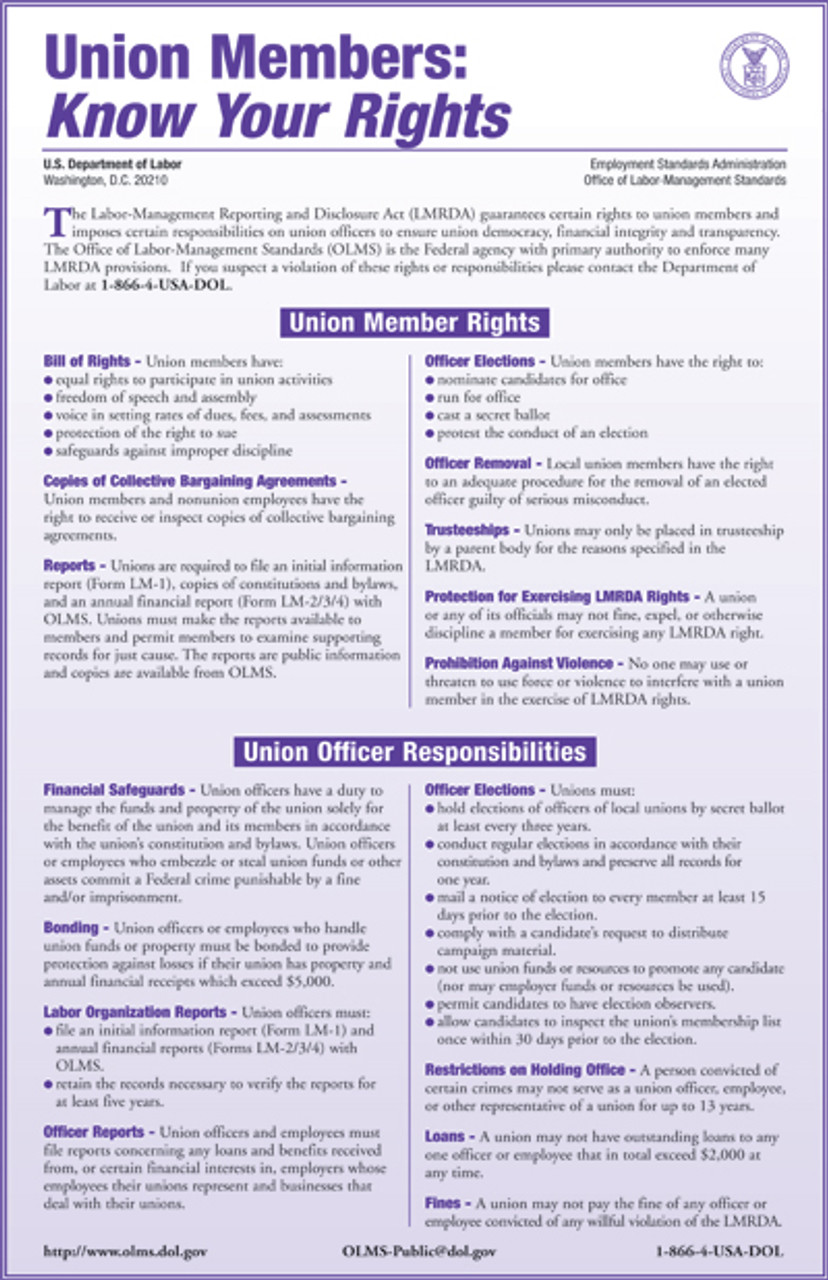
Help union members understand their rights and union officer responsibilities with the Union Members: Know Your Rights Poster. This 11 x 17-inch federal specialty poster provides a convenient overview of important rights and protections established under the Labor-Management Reporting and Disclosure Act (LMRDA).
The LMRDA establishes important standards for union democracy, financial integrity, union officer elections, reporting and disclosure, trusteeships, and the protection of union members' rights.
What Is the Labor-Management Reporting and Disclosure Act?
The Labor-Management Reporting and Disclosure Act of 1959 (LMRDA) is a federal law that protects certain rights of union members and establishes requirements intended to promote democratic procedures, financial transparency, and responsible administration within labor organizations.
The U.S. Department of Labor's Office of Labor-Management Standards (OLMS) administers and enforces many provisions of the LMRDA.
What Rights Do Union Members Have Under the LMRDA?
Title I of the LMRDA establishes a Bill of Rights for members of labor organizations. Depending on the union and applicable law, protected rights include:
- Equal rights to participate in union activities
- Equal rights to nominate candidates for union office
- The right to vote in union elections and referendums
- The right to attend and participate in union meetings
- Freedom of speech and assembly
- A voice in setting union dues, fees, and assessments
- Protection of the right to sue
- Safeguards against improper disciplinary action
- Access to applicable collective bargaining agreements
- The right to receive information about LMRDA protections
Union Members' Freedom of Speech and Assembly
Union members covered by the LMRDA generally have the right to meet and assemble freely with other members and to express views, arguments, and opinions concerning union affairs.
Members also have the right, subject to reasonable union rules, to express their views at union meetings regarding candidates for union office and other matters properly before the membership.
Union Officer Election Rights
The LMRDA establishes standards intended to protect fair and democratic union officer elections.
Union member election rights can include:
- A reasonable opportunity to nominate candidates
- The right of eligible members to be candidates for union office, subject to reasonable and uniformly imposed qualifications
- The right to vote for and support candidates without improper interference or reprisal
- Secret-ballot elections where required
- Advance notice of applicable union elections
- The right of candidates to have observers at polling and ballot-counting locations
- Adequate safeguards to help ensure fair elections
How Often Must Union Officers Be Elected?
The LMRDA establishes maximum periods between regularly scheduled union officer elections.
- Local unions: officers must generally be elected at least once every 3 years
- Intermediate bodies: officers must generally be elected at least once every 4 years
- National and international unions: officers must generally be elected at least once every 5 years
Applicable union constitutions and bylaws may require elections more frequently.
Union Dues, Fees and Assessments
The LMRDA gives union members a voice in decisions concerning increases in union dues, initiation fees, and assessments.
Applicable increases must follow democratic procedures established by federal law. The procedures vary depending on whether the organization is a local union, intermediate body, national union, international union, or federation.
Union Financial Reports and Transparency
The LMRDA establishes reporting and disclosure requirements intended to provide union members and the public with information about labor organizations and their financial activities.
Covered unions must file applicable reports with the U.S. Department of Labor's Office of Labor-Management Standards. Depending on the organization, required filings can include:
- Union information reports
- Union constitutions and bylaws
- Annual financial reports
- Other reports required under the LMRDA
Many reports filed with OLMS are public records and can be reviewed through the Department of Labor's public disclosure resources.
Union Officer Responsibilities
Union officers hold positions of trust and have important responsibilities concerning union funds, property, elections, records, and administration.
Responsibilities addressed by the LMRDA can include:
- Managing union funds and property for the benefit of the organization and its members
- Maintaining applicable financial records
- Filing required labor organization reports
- Complying with union officer election requirements
- Following applicable bonding requirements
- Protecting union assets
- Complying with restrictions involving certain loans and financial interests
Bonding Requirements for Union Officials
The LMRDA establishes bonding requirements for certain union officers and employees who handle union funds or property.
Bonding helps protect labor organizations and their members against certain losses caused by fraudulent or dishonest acts involving union funds or property.
Union Trusteeships
A trusteeship occurs when a parent labor organization suspends some or all of the autonomy normally exercised by a subordinate labor organization.
The LMRDA establishes standards governing the establishment and administration of trusteeships and provides procedures for challenging trusteeships that may violate federal requirements.
Right to Inspect Collective Bargaining Agreements
Union members and employees whose rights are directly affected by a collective bargaining agreement generally have rights concerning access to that agreement under the LMRDA.
Union members should understand how to obtain or inspect applicable collective bargaining agreements and where to seek assistance if access is improperly denied.
Protection Against Improper Union Discipline
The LMRDA provides safeguards against certain improper disciplinary actions by labor organizations.
Before a union member may be fined, suspended, expelled, or otherwise disciplined in applicable circumstances, the member generally must receive:
- Written specific charges
- Reasonable time to prepare a defense
- A full and fair hearing
Can Union Members Sue to Enforce Their Rights?
Union members have important rights to pursue legal remedies. Under the LMRDA, a union generally may not improperly limit a member's right to bring a lawsuit or administrative proceeding, appear as a witness, or communicate with legislators.
In certain circumstances, a union member may be required to use reasonable internal union hearing procedures for up to four months before bringing an outside action.
Who Enforces Union Member Rights?
The U.S. Department of Labor's Office of Labor-Management Standards (OLMS) enforces many provisions of the LMRDA, including certain reporting, election, trusteeship, bonding, and financial-integrity requirements.
Some LMRDA rights, including portions of the union members' Bill of Rights, may need to be enforced directly by union members through a private action in federal district court.
Does the LMRDA Cover Every Union?
No. The LMRDA generally covers labor organizations representing private-sector employees and U.S. Postal Service employees.
Federal-sector unions are generally subject to similar standards of conduct under the Civil Service Reform Act. Unions composed solely of state, county, or municipal government employees are generally not covered by the LMRDA or the federal-sector standards of conduct provisions administered under the CSRA.
Union members should determine which federal or state law applies to their particular labor organization.
Is the Union Members: Know Your Rights Poster Required?
The LMRDA requires covered unions to inform their members about the provisions of the Act, including applicable union member rights. However, employers and labor organizations should determine whether a particular poster or method of notification is required for their specific organization and circumstances.
This Union Members: Know Your Rights Poster can help communicate important federal union-member rights and officer responsibilities, but it should not be treated as a substitute for required union notices, reports, election procedures, collective bargaining agreements, or other obligations under applicable federal or state law.
Union Members Poster Specifications
- 11"W x 17"H
- Portrait orientation
- Printed in full color
- Laminated with high-quality laminate
- Federal union member rights specialty poster
Federal Workplace Rights and Compliance Resources
Labor Law Compliance Center provides employers, labor organizations, and workplaces with federal and state labor law posters, federal specialty notices, workplace rights posters, and compliance resources throughout the United States. Browse our Federal Specialty Posters for additional federal workplace rights and compliance notices.