Description
Employee Rights for Workers with Disabilities – Special Minimum Wage Poster
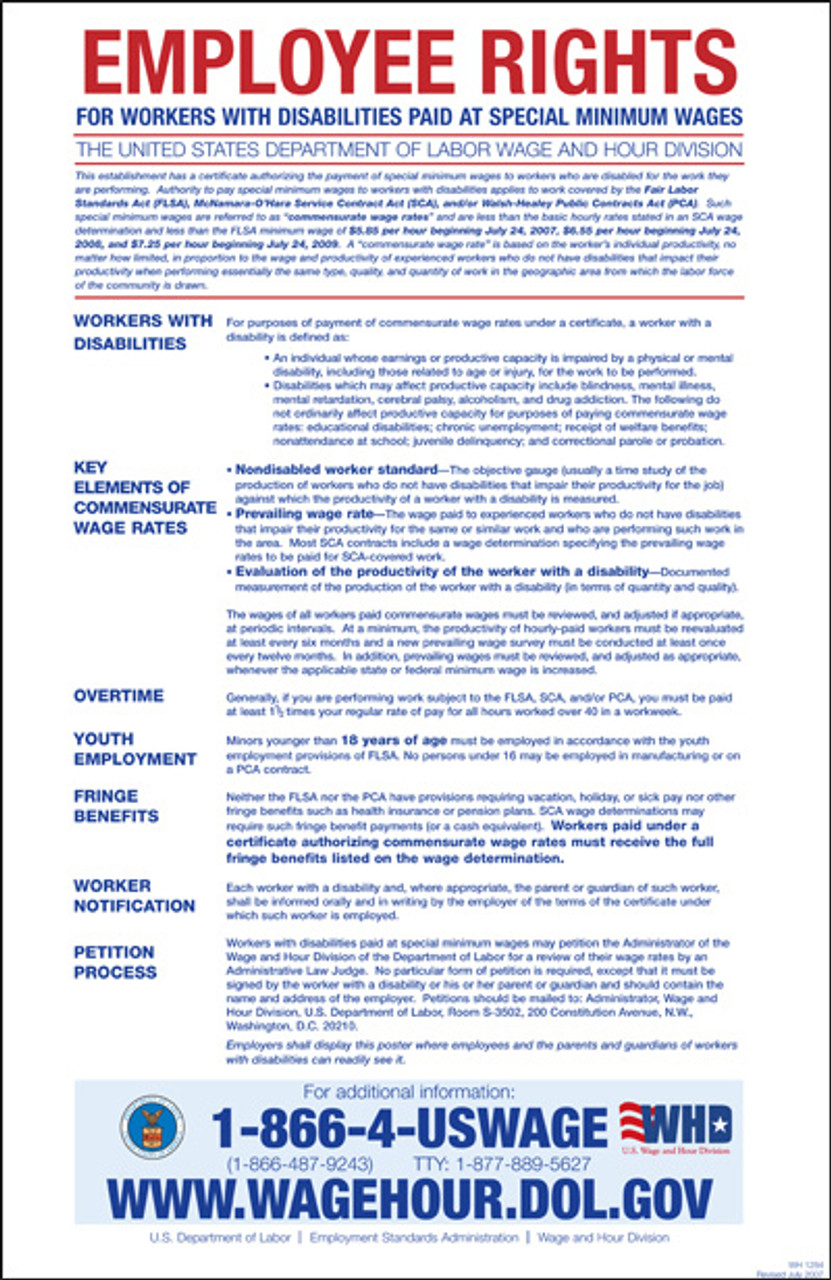
Help satisfy applicable federal workplace posting requirements with the Employee Rights for Workers with Disabilities – Special Minimum Wage Poster. This 11 x 17-inch federal notice explains employee rights and employer responsibilities when workers with disabilities are paid special minimum wages under certificates authorized by federal law.
Employers of workers with disabilities who are paid special minimum wages under applicable certificates authorized by Section 14(c) of the Fair Labor Standards Act, the McNamara-O'Hara Service Contract Act, and/or the Walsh-Healey Public Contracts Act must display the prescribed U.S. Department of Labor notice.
What Is FLSA Section 14(c)?
Section 14(c) of the Fair Labor Standards Act (FLSA) permits employers holding an appropriate certificate issued by the U.S. Department of Labor to pay certain workers with disabilities a commensurate wage based on the worker's individual productivity for the work being performed.
An employer may not simply decide to pay a worker with a disability less than the applicable minimum wage. The employer must meet applicable federal requirements and obtain authorization from the U.S. Department of Labor before paying a special minimum wage under Section 14(c).
What Is a Special Minimum Wage?
A special minimum wage is a wage permitted under an applicable U.S. Department of Labor certificate that may be below the otherwise applicable federal minimum wage.
The wage must be a commensurate wage based on the worker's productivity in comparison with the productivity of experienced workers who do not have disabilities performing essentially the same type, quality, and quantity of work in the same geographic area.
What Is a Commensurate Wage?
A commensurate wage is a wage rate that reflects the relationship between a worker's individual productivity and the prevailing wage for the job being performed.
Employers using Section 14(c) must follow applicable Department of Labor procedures for determining prevailing wages, measuring employee productivity, calculating commensurate wage rates, and periodically reviewing those rates.
Who Can Be Paid a Special Minimum Wage?
Section 14(c) applies only when an employee's earning or productive capacity for the work being performed is impaired by a physical or mental disability, including disabilities related to age or injury.
The existence of a disability alone does not automatically permit payment of a special minimum wage. The disability must affect the employee's productive capacity for the particular work being performed, and the employer must hold the appropriate federal certificate.
Who Must Post the Workers with Disabilities Notice?
Employers of workers with disabilities who receive special minimum wages under certificates authorized by the Fair Labor Standards Act, McNamara-O'Hara Service Contract Act, and/or Walsh-Healey Public Contracts Act must display the prescribed Employee Rights for Workers with Disabilities Paid at Special Minimum Wages notice.
The posting requirement applies to employers using the applicable special minimum wage authority. It is not a general workplace posting requirement for every employer that employs an individual with a disability.
Where Must the Special Minimum Wage Poster Be Displayed?
The required notice must be displayed in a conspicuous location on the employer's premises where employees and the parents or guardians of workers with disabilities can readily see it.
Appropriate locations may include:
- Employee bulletin boards
- Employee entrances
- Work areas
- Break rooms
- Human Resources areas
- Training areas
- Other conspicuous locations accessible to affected workers and their parents or guardians
What Information Must Workers Receive?
In addition to displaying the required poster, each worker with a disability who receives a special minimum wage must be informed about the terms of the certificate under which the worker is employed.
Where appropriate, the worker's parent or guardian must also receive this information.
The employer must provide the information orally and in writing. Applicable requirements may be satisfied by making copies of the special minimum wage certificate available as required by federal law.
How Are Special Minimum Wages Determined?
Special minimum wages must be based on the worker's productivity compared with the productivity of experienced workers without disabilities performing essentially the same work.
Employers must establish an appropriate prevailing wage for the job and evaluate the individual worker's productivity according to applicable Department of Labor requirements.
The employer bears responsibility for demonstrating that the commensurate wage rate has been properly determined.
Must Productivity Be Reevaluated?
Employers paying special minimum wages must periodically review employee productivity and applicable wage information so that commensurate wage rates continue to reflect the employee's current productive capacity and the prevailing wage for the work.
A worker's special minimum wage should therefore not simply remain unchanged indefinitely when the employee's productivity or applicable prevailing wage changes.
Can a Worker Challenge a Special Minimum Wage?
Workers paid special minimum wages under Section 14(c) have rights concerning the wage rates established by their employers.
An employee, parent, or guardian may seek review of applicable special minimum wage determinations under procedures established by federal law.
Workers who have questions about special minimum wage requirements may also contact the U.S. Department of Labor Wage and Hour Division for information or assistance.
Section 14(c) and the Workforce Innovation and Opportunity Act
Additional federal requirements apply to certain individuals with disabilities under Section 511 of the Rehabilitation Act, as amended by the Workforce Innovation and Opportunity Act (WIOA).
These requirements can include career counseling, information and referral services, and other conditions that must be satisfied before certain individuals may begin or continue receiving a subminimum wage.
Employers using Section 14(c) certificates should comply with both applicable Wage and Hour Division requirements and any additional requirements governing the workers they employ.
Does the Americans with Disabilities Act Allow Lower Wages?
A disability by itself does not authorize an employer to pay an employee less than the applicable minimum wage.
Special minimum wages are governed by specific federal requirements, including Section 14(c) certification and commensurate wage procedures. Employers must also comply with applicable disability discrimination laws, including the Americans with Disabilities Act when applicable.
Is the Workers with Disabilities Poster Federally Required?
Yes, for employers paying workers with disabilities special minimum wages under applicable federal certificates.
Employers subject to the requirement must display the prescribed Employee Rights for Workers with Disabilities Paid at Special Minimum Wages notice in a conspicuous location where affected employees and their parents or guardians can readily see it.
This is not a universally required poster for every employer that employs a worker with a disability. It applies specifically to employers using applicable federal special minimum wage authority.
Current Workers with Disabilities Poster Version
The current U.S. Department of Labor Employee Rights for Workers with Disabilities Paid at Special Minimum Wages poster is WH Publication 1284, revised January 2018.
Employers should ensure that the notice displayed at the workplace contains the current required employee-rights information.
Workers with Disabilities Poster Specifications
- 11"W x 17"H
- Portrait orientation
- Printed in full color
- Laminated with high-quality laminate
- Federal special minimum wage employee-rights notice
Federal Workplace Posting and Compliance Resources
Labor Law Compliance Center provides employers and government contractors with federal and state labor law posters, employee rights notices, federal contractor postings, specialty posters, and compliance resources throughout the United States. Browse our Federal Labor Law Posters for additional individual federal workplace notices and compliance products.