Description
Dishwashing & Warewashing Food Safety Poster
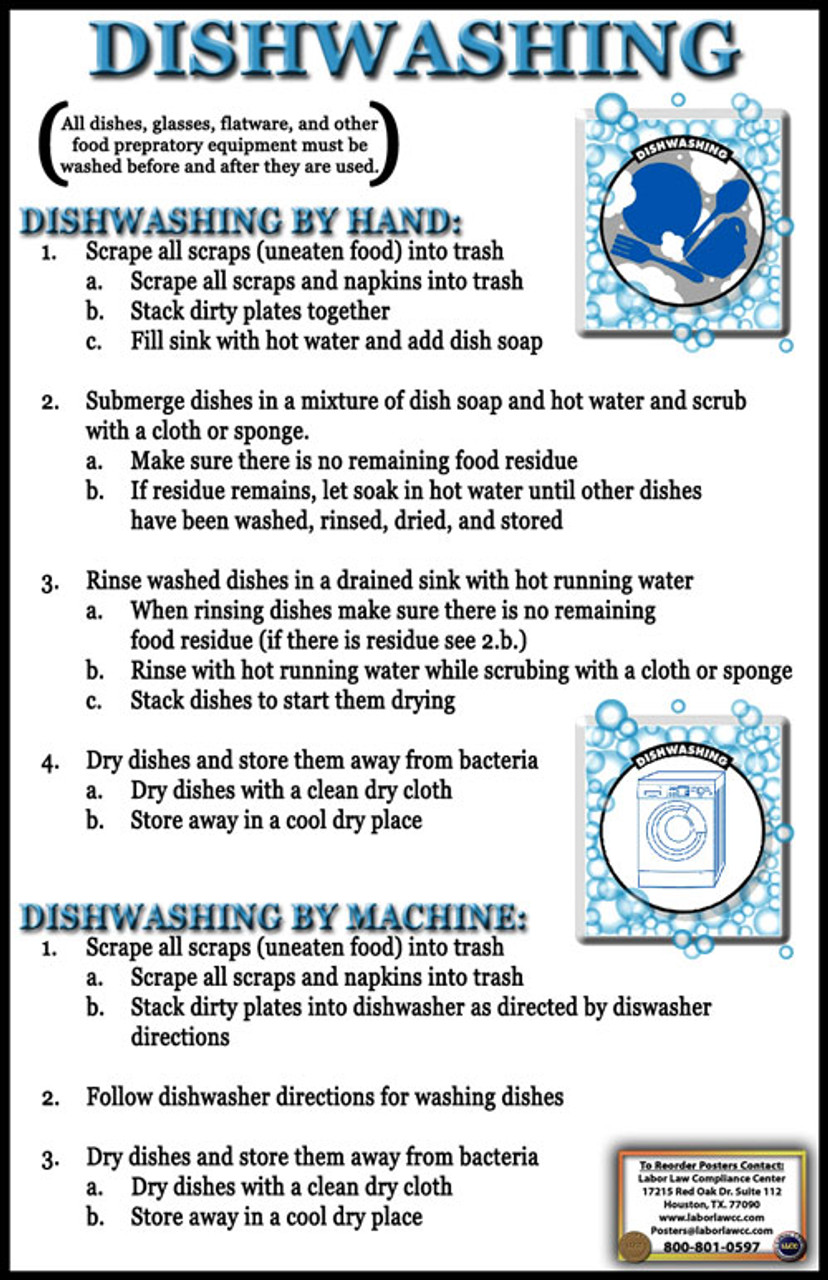
Help employees properly clean and sanitize dishes, utensils, and food-contact equipment with the Dishwashing & Warewashing Food Safety Poster. This 11 x 17-inch food safety poster provides employees with a convenient visual reference for proper dishwashing procedures using both manual and mechanical warewashing methods.
Proper washing, rinsing, and sanitizing helps remove food residue, grease, cleaning chemicals, and harmful microorganisms from dishes, utensils, and food-contact surfaces. Following established warewashing procedures is an important part of maintaining sanitary conditions in restaurants, commercial kitchens, cafeterias, and other food-service operations.
What Is Warewashing?
Warewashing is the cleaning and sanitizing of food equipment, utensils, dishes, glassware, and other food-contact items. Warewashing may be performed manually using an appropriate sink system or mechanically using a commercial dishwashing machine.
Regardless of the method used, employees should follow established procedures to ensure food-contact items are properly cleaned, rinsed, sanitized, and allowed to dry before reuse.
What Are the Basic Steps for Washing Dishes by Hand?
Manual warewashing generally follows a wash, rinse, sanitize, and air-dry process. Employees should follow applicable food-safety requirements and workplace procedures.
- Pre-clean – Scrape, remove, or rinse away food scraps and heavy soil before washing.
- Wash – Wash dishes, utensils, and equipment using an appropriate detergent solution.
- Rinse – Rinse items with clean water to remove detergent, loosened food particles, and other residue.
- Sanitize – Sanitize food-contact items using an approved chemical sanitizer or hot-water method as applicable.
- Air Dry – Allow cleaned and sanitized items to air dry before storage or reuse.
How Does a Three-Compartment Sink Work?
The FDA Food Code generally calls for a sink with at least three compartments for manual warewashing. The compartments allow employees to perform the major steps separately:
- First compartment – Wash
- Second compartment – Rinse
- Third compartment – Sanitize
Before washing, employees should scrape or otherwise remove accumulated food debris. Sink compartments and surrounding warewashing areas should be maintained in sanitary condition, and wash, rinse, and sanitizing solutions should be kept clean.
What Temperature Should Manual Dishwashing Water Be?
Under the FDA Food Code, the wash solution in manual warewashing equipment generally must be maintained at not less than 110°F (43°C) or at the temperature specified on the cleaning agent manufacturer's label instructions.
If hot-water immersion is used for manual sanitizing, the FDA Food Code specifies a water temperature of at least 171°F (77°C). Employees should follow the procedures and equipment requirements adopted by their applicable regulatory authority.
Chemical Sanitizing for Dishes and Utensils
Food establishments may use approved chemical sanitizers when permitted by applicable food-safety requirements. The correct sanitizer concentration, temperature, contact time, and other conditions depend on the chemical being used and applicable regulatory and manufacturer requirements.
Employees should follow product label instructions and workplace procedures and use an appropriate test kit or other approved testing device to verify sanitizer concentration when required.
Mechanical Dishwashing and Warewashing Machines
Commercial dishwashing machines can clean and sanitize dishes and utensils using hot water or approved chemical sanitizers. Employees should operate warewashing machines according to manufacturer instructions and applicable food-safety requirements.
Important practices can include:
- Remove excess food and debris before loading items
- Load racks so wash and rinse solutions can reach food-contact surfaces
- Use the correct detergent and sanitizer
- Monitor required wash and sanitizing temperatures or chemical concentrations
- Keep spray arms, nozzles, screens, and other components clean
- Report equipment that is not operating properly
- Allow cleaned and sanitized items to air dry before storage
Why Is Sanitizing Important?
Cleaning and sanitizing perform different functions. Cleaning removes food residue, grease, soil, and other material from a surface. Sanitizing is performed after cleaning to reduce microorganisms on properly cleaned food-contact surfaces to safe levels.
Food-contact surfaces and utensils should therefore be properly cleaned before they are sanitized.
Why Should Dishes Air Dry?
After washing, rinsing, and sanitizing, dishes and utensils should be allowed to air dry according to applicable food-safety procedures rather than being dried with potentially contaminated towels.
Proper drying and storage can help prevent cleaned food-contact surfaces from becoming contaminated before they are used again.
FDA Food Code and Dishwashing Requirements
The FDA Food Code provides model food-safety provisions covering manual and mechanical warewashing, cleaning, rinsing, sanitizing, equipment, water temperatures, chemical sanitizers, and food-contact surfaces.
The FDA Food Code is a model code used by state, local, tribal, and territorial regulatory authorities when developing food-service and retail food regulations. Individual jurisdictions may adopt or modify Food Code provisions, so food establishments should follow the requirements enforced by their applicable regulatory authority.
Where Can a Dishwashing Poster Be Displayed?
The Dishwashing & Warewashing Food Safety Poster can provide a useful employee reference in locations such as:
- Restaurants and commercial kitchens
- Three-compartment sink areas
- Dishwashing and warewashing stations
- School and institutional cafeterias
- Hotels and hospitality kitchens
- Grocery store kitchens and delis
- Catering operations
- Healthcare food-service operations
- Food preparation facilities
- Employee food-safety training areas
Is a Dishwashing Poster Required?
Food establishments are subject to applicable food-safety requirements governing the cleaning and sanitizing of dishes, utensils, equipment, and food-contact surfaces. However, this particular Dishwashing & Warewashing Food Safety Poster is intended as a supplemental employee food-safety and training resource and should not be represented as a universally required workplace poster.
This poster does not replace applicable food-safety regulations, employee training, equipment instructions, sanitizer requirements, workplace procedures, or requirements established by the applicable state or local regulatory authority.
Dishwashing Poster Specifications
- 11"W x 17"H
- Portrait orientation
- Printed in full color
- Laminated with high-quality laminate
Food Safety and Workplace Compliance Resources
Labor Law Compliance Center provides employers with labor law posters, workplace policy posters, workplace safety posters, food-safety materials, specialty postings, and compliance resources for businesses throughout the United States. Browse our Workplace Policy Posters for additional employee policy, hygiene, food-safety, and workplace awareness materials.